
Is the vetting process for NativeCamp's online English teachers discriminatory?
Blaming technology bugs is easy enough to believe, but Reddit and Glassdoor sum up NativeCamp's job application process as racist

“I don’t know.”
“Yes.”
“No.”
Those were the only three words or phrases one of my relatives could say at the beginning stages of a stroke. No one in my family had ever had a stroke before, so recognizing the signs of FAST were completely out of my wheelhouse. But there were two things that were definitely in my wheelhouse once she was out of the hospital: reading news and practicing English writing lessons. With a bachelor’s degree in English and always buried in a book, I was excited when her speech therapist asked me if I was interested in helping my family member with vocabulary and reading lessons.
Once I found out about the site NewsInLevels.com, I was in business. Once or twice a week, we would schedule a time to speak online. She would read ESL news briefs to me, and I would monitor her speaking and reading comprehension levels. Some days she didn’t want to do it. Other days she was excited to read. I bought a kids’ book with her favorite wildlife animal, and that made rough days more interesting for her.
Although I’d never humored the idea of being an online instructor until her stroke, I realized I really liked working on educational material for people who were having challenges in reading or it wasn’t their first language. (I would occasionally help visa students in college, but I also had 50 pen pals as a kid and English was the native language for only about 50% of them.) Within a couple of months, she regained her vocabulary and 85% of her old speaking voice. She never regained her love for math at the same level, but you would have no idea she ever had a stroke from her physical appearance.
ADVERTISEMENT ~ Amazon
As an Amazon affiliate, I earn a percentage for each sale made with my referral links on this page.

Applying for a NativeCamp remote job
But I still wanted to do something with this ESL lesson plan I’d been participating in. NativeCamp seemed like my answer. Although the pay is a consistent complaint on Glassdoor ($1.60-$2.50 for newcomers completing 25-minute lessons with students), I was more interested in the work with “one of Japan’s largest online ESL English tutoring schools, with teachers from all over the world.”
I took the artificial intelligence test and scored 95%. I took the audio test and scored 87%. (The latter score confused me considering I’m a native English speaker, have completed a little under 260 interviews, was a Toastmasters president and competition speaker, participated in multiple book signings, and was a yearlong host of a storytelling series in Chicago. I have professional flaws, but public speaking is not one of them.)
Recommended Read: “Is applying for the DataAnnotation job worth it ~ BlackTechLogy: The 45-minute artificial intelligence editing test was my second round at working on AI writing”
Still, I shrugged. Even though I’ve never been the highest scorer on standardized tests, I graduated Cum Laude. (Or, as my grandfather would say, “Ooh lawdy!”) Maybe my reading voice (rarely if ever) betrayed me too.
The NativeCamp Demo Lesson that never happened
I smiled at the next step, the Learning Kit, and was almost giddy to do the Demo Lesson for NativeCamp. This was exactly like the kind of lesson plan I completed in collaboration with my family member’s speech therapist. After passing the computer speed, audio and video test to make sure my equipment was compatible with NativeCamp’s specifications, I was ready to go.
ADVERTISEMENT ~ Amazon
As an Amazon affiliate, I earn a percentage from purchases with my referral links. I prioritize featuring intriguing products from small businesses, women-owned businesses and Black-owned businesses. All four of my Substack publications include a MINIMUM of one product sold by a VERIFIED Black-owned business.

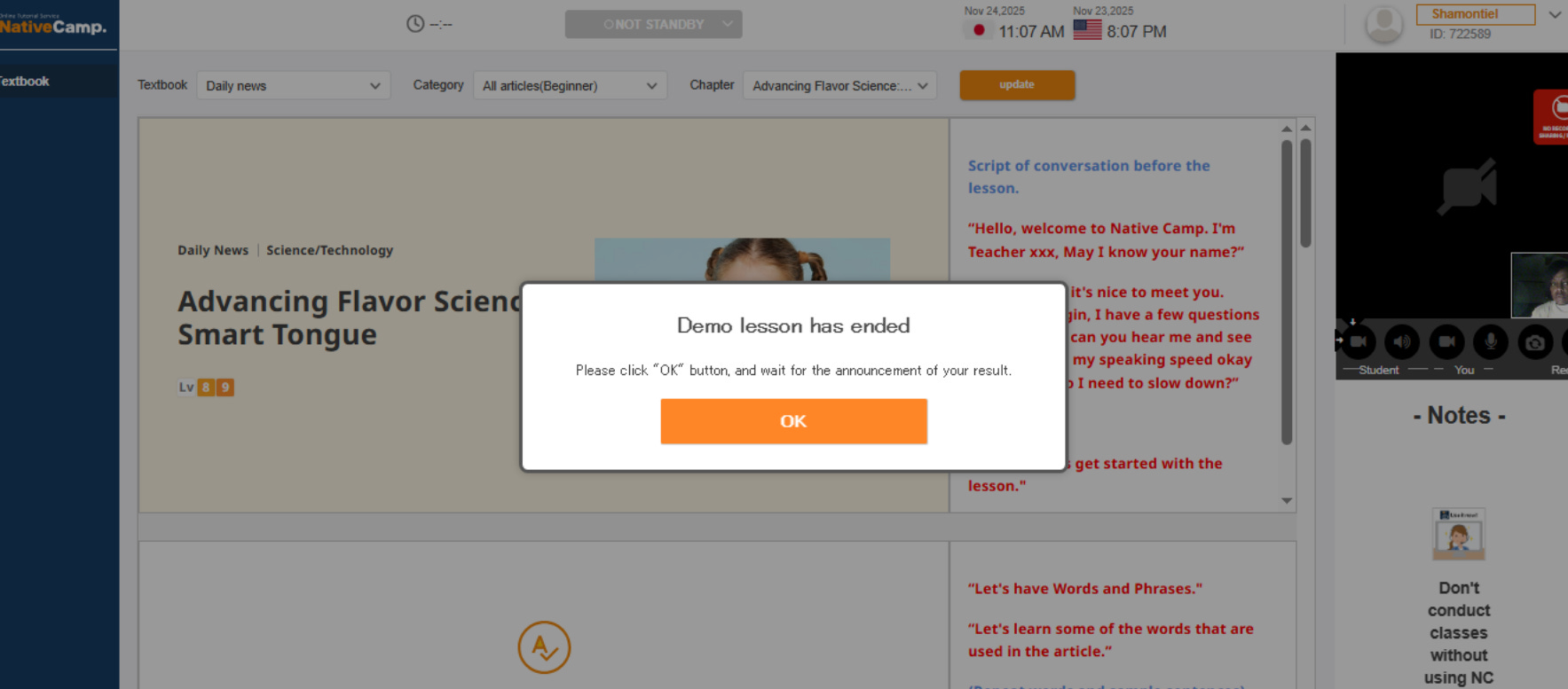
Or not. No matter how many times I logged in to take the demo test — with my camera on and headphones in place — a message kept popping up that my demo ended. So I tried again and again and again. By the fifth time, it felt the same way as someone who keeps getting sent to voicemail when you know the standby recruiter is supposed to be testing applicants. I tried not to jump to conclusions, reading through FAQs and Tech Support chat. Sixth time, rejected. And one particular line in the FAQs caught my attention:
“You will only have three attempts for the Demo Lesson (but there is a chance that you will fail on your first try if we see no potential). It is no longer possible to retake the Demo class once you have reached the limit. Please take the time to thoroughly prepare before performing your Demo Lesson.”
But how do you know if you do have potential if the demo recruiter keeps rejecting you in standby mode before you can say a word from the online textbook material? And what is considered “no potential”? I looked at the Glassdoor scores of NativeCamp and grew concerned — African-American employee scores were 2.6 out of 5 versus Asian scores of 4.5 out of 5 and White employee scores of 3.1 out of 5.

With a 2.4 out of 5 interview process score and applicants’ accusations about rude admins, demands for passport proof, challenges about people’s citizenship, and a noticeable amount of complaints on Reddit about race and suspicious rejections for not “sounding native,” I was noticing a pattern for people of color.
One Reddit user bluntly stated, “Admin staff and owners of NC are also a bit racist since they don’t want black teachers because Japanese people don’t like them.” (I sorta disagree with this assessment solely from my own experience befriending Japanese students at my first college, one of which I taught how to drive; who lost her mind devouring collard greens at my family's Thanksgiving table; and, on a separate date, visited the Taste of Chicago. I will, however, admit that she turned into a completely different person when her mother arrived for her graduation in California and seemed stressed out at everything her mother said — who only spoke Japanese. Meanwhile, me and another Black woman college alum partied all night at a Cali club with a group of her Japanese friends. Even though it was her graduation night, she stayed home with her mom.)
Still, I started wondering if NativeCamp is racist. Is NativeCamp’s demo vetting process weeding out anybody who doesn’t “look” a specific way, never mind how they talk? It’s unclear.
Based in Tokyo, Japan, with a 1.5 score on TrustPilot, NativeCamp applicants (especially Black applicants) may be wasting their time with this online teaching platform. I wiped my hands of it, knowing that repeatedly trying to stay in “standby” for the demo was tedious.
If you’re really interested in online tutoring, consider volunteer work. Reach out to schools who are looking for paid or volunteer tutors. Ask local hospitals about stroke survival meetings. Pitch your paid services on LinkedIn. There’s no point in fighting to work for a company that seems to be giving all the signals that it is looking for a certain look in order for you to work with them. Look elsewhere.

Did you enjoy this post? You’re also welcome to check out my Substack columns “Black Girl In a Doggone World,” “BlackTechLogy,” “Homegrown Tales,” “I Do See Color,” “One Black Woman’s Vote” and “Window Shopping” too. Subscribe to this newsletter for the weekly posts every Wednesday. Thanks for reading!